Counter placement strategies
Every site carries 3 to 5 counters. Their positions determine the arithmetic applied to their tracks, so placement is not cosmetic: it defines what the site's numbers mean.
Two families
| Family | Arithmetic | Arrangements |
|---|---|---|
| Gateway | Counters watch the same traffic. They merge into one counting point: per 15-minute window, the site reports the most tracks any member saw. | Stack, Chain |
| Coverage | Counters watch different stretches. The site still reports the most tracks any point saw per window. | Spread |
Both families take a busiest-member floor; they differ only in how far it reaches (one merged point, or the whole site). Counters' tracks never add up inside a site, so no site's number can be inflated by how it is labeled. Adding happens across sites: network and corridor totals sum the site floors. A place whose separate entrances each deserve their own count is several sites, not a special site type. The platform decides merging from the counters' actual positions: units within 400 feet of each other along a path merge; units farther apart count separately.
Gateway arrangements
Stack
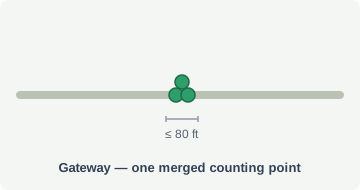
All counters within 80 feet of one spot, usually facing opposite directions to widen the watched area. One counting point. If a unit fails, the others carry the count with no gap. Used at a single choke point and for accuracy calibration.
Chain
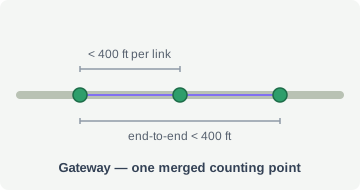
3–5 counters along a short stretch of one path, each link under 400 feet and the whole chain under 400 feet end to end. Everyone entering passes all of them, so they still merge into one counting point, but a fallen limb, a battery failure, or vandalism at any single post costs nothing. This is the standard arrangement for entrances.
Worked example, one 15-minute window at a chain of three counters:
| Counter | Count in window |
|---|---|
| A | 7 |
| B | 6 |
| C | 7 |
| Site reports | 7 |
Seven people walked past all three counters; B missed one. The site takes the most complete picture (7), not the sum (20).
One boundary case: a person who crosses the chain across a 15-minute boundary (first counters at 14:13, last at 14:16) lands in both the 14:00 and 14:15 windows and is counted in each. Keeping chains short keeps this rare, which is why chain length is limited.
A forked path is also a chain. Put a stacked pair on the shared stretch (everyone passes it) and one counter down each branch: the site reports the shared stretch's count, and the branch counters add the left-versus- right split plus backup coverage.
Coverage arrangements
Spread
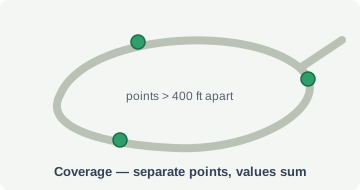
Counters placed far apart (over 400 feet) across a trail network: loops, forks, interior mileage. Each point measures its own stretch, and the per-point numbers stay visible as observed tracks. The site's Counts total merges the points: per 15-minute window the site reports the most tracks any point saw, so one walker who passes 3 of the points on a loop counts once, not three times. Counters inside a site never double-count. Points closer than 400 feet simply merge into one counting point; the site's total is unaffected. Spread sites exist to measure the whole network: every point replaces an assumption in the network usage model with a measurement.
Fenced areas
Place counters at the gate, not inside the fence (inside they would count play and wandering rather than arrivals). One stacked pair at the gate does the whole job, and the crossings pair up exactly: everyone who enters also leaves, so distinct visits to the area are half the gate crossings the site reports. An area with several entrances that each deserve their own count is several gate sites; the network total adds them together.
If a counter fails
| Arrangement | Effect of one lost unit |
|---|---|
| Stack | None; the others carry the count |
| Chain | None; the others carry the count |
| Spread | Site total continues on the other points; that stretch’s observed tracks pause |
A paused counter's data is never invented. Gaps stay visible.
Positions are versioned
The platform records where every counter stood on every day, and site numbers are computed from the positions in effect at the time. If a counter is moved, swapped, or added, or a site's arrangement is corrected, history is recomputed from the original sensor pings under the corrected layout.